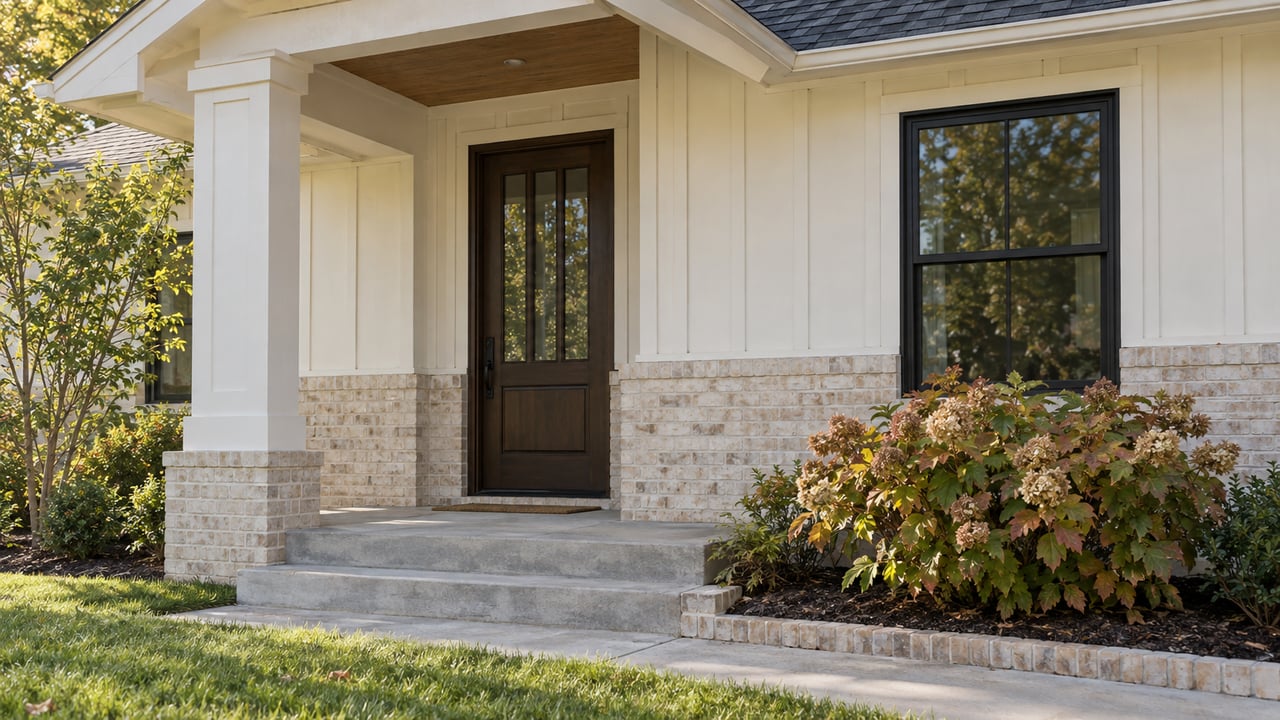
Drive along Green Level Church Road or McCrimmon Parkway through Amberly on a Saturday morning and nothing marks the spot. No sign, no change in pavement, no shift in the landscaping that Amberly's Residents Club maintains block by block. But somewhere under those streets, Wake County ends and Chatham County begins. Chatham County's own planning documents name Amberly and Weldon Ridge specifically as communities where part of the land sits inside Chatham County and part sits inside Wake, all while every parcel remains inside Cary's town limits.
That line does not show up on a listing sheet. It does not show up in a portal search filter. It shows up in late summer, when the tax bill arrives from a different county office than your neighbor's does, calculated off a different rate.
Cary Is Not One County
Most buyers assume a town has one government layer under it besides city hall. Cary breaks that assumption. Cary's own tax office explains it directly: property inside Cary sits in one of three counties, Wake, Chatham, or Durham, and each county handles its own assessment, valuation, billing, and collection independently of the others. The town sets one municipal tax rate that applies inside its limits, but the county each parcel happens to sit in still runs its own budget cycle, its own reappraisal schedule, and its own tax office.
Geographically, most of Cary sits in western Wake County, with a section in the northeast corner of Chatham County and a smaller slice in southwest Durham County, according to the town's recorded boundaries. The Chatham piece is not a rural leftover on the edge of town. It runs through some of the newest, most actively marketed subdivisions in West Cary, including parts of Amberly and Weldon Ridge, per Chatham County's own land use planning documentation.
What That Line Actually Charges You
Two houses in the same Amberly section, same builder, same floor plan, same year, can end up on different county tax rolls. That means different rates stacked on top of the same Cary town rate.
Cary's town council adopted a 2.75-cent increase for the fiscal year that began July 1, 2026, bringing its municipal rate to 36.75 cents per $100 of assessed value. That part is the same no matter which county a lot sits in. What changes is the county layer underneath it.
| County covering the parcel | Current county rate (per $100) | Plus Cary's town rate | Combined rate |
|---|---|---|---|
| Wake | $0.5371 | $0.3675 | $0.9046 |
| Chatham | $0.6000 | $0.3675 | $0.9675 |
| Durham | Not published in this research | $0.3675 | Contact Durham County directly |
Wake County's current rate reflects a two-cent increase the county adopted for the same fiscal year, bringing it to 53.71 cents per $100. Chatham County held its rate flat at 60 cents per $100 when it adopted its own budget for the same period. Stack either one under Cary's town rate and the Chatham side comes out roughly 6.3 cents per $100 higher than the Wake side.
On a home assessed near $639,000, close to Amberly's median sold price in June 2026, that gap works out to about $400 a year, using this year's published rates alone. That figure does not include any fire tax district charge or solid waste fee, so an actual bill could move further in either direction.
The Real Complication Isn't the Rate, It's the Clock
A flat $400 gap would be simple enough to plan around. The harder problem is that the gap does not stay put.
Chatham County last completed a countywide property revaluation in 2025, with its next one scheduled for 2029, according to the North Carolina Department of Revenue's published county tax rate table. That reappraisal is why Chatham's rate for this fiscal year, $0.60, actually dropped from the prior year's $0.7250. Fresh assessments pushed property values up, so the board lowered the rate to avoid an automatic windfall.
Wake County runs its own revaluation calendar, set independently by Wake's own commissioners and assessor's office, not synchronized to Chatham's timing. That means the two halves of the same Amberly street can be sitting on assessed values from two different points in the market cycle at any given moment. When Chatham revalues again in 2029, its assessed values will jump toward that year's market prices while Wake's assessed values keep drifting on whatever schedule Wake has set for itself. The rate gap between the two sides of that Amberly street is not a fixed number. It is a moving target that widens or narrows depending on which county last took a fresh look at land values, and when.
For a buyer comparing two listings that look identical on paper, this means the tax line on a closing disclosure is not just a fact to confirm. It is a number that could shift meaningfully by the next reappraisal, in either direction, for reasons that have nothing to do with the house itself.
A Few More Places the Line Shows Up
The Chatham sliver isn't the only place jurisdiction gets complicated in Cary, though it's the one with the clearest financial stakes.
- Cary's small Durham County section works the same way in principle: a separate tax office, a separate assessment calendar, handled through the Durham County Tax Administrator rather than Wake or Chatham.
- Chatham County Schools and Wake County Public School System are separate school systems.
- Cary shares a different kind of overlapping boundary with its neighbor Morrisville around the Preston community, where the line in question is a town limit rather than a county line. That distinction matters because a town boundary changes which municipal services and ordinances apply, while a county boundary changes who bills and assesses your property taxes. They're easy to conflate and worth keeping separate when you're comparing two communities that look similar on a map.
None of this makes West Cary a bad place to buy. It makes it a place where the paperwork behind a listing deserves one more look before an offer goes in.
How to Check Before You Write an Offer
The parcel record settles this in minutes, not the marketing brochure. A few concrete steps before falling for a specific lot:
- Ask which county's revenue department the seller's current tax bill comes from. Wake County Tax Administration can be reached at 919-856-5400, Chatham County's Collection Division at 919-542-8250, and the Durham County Tax Administrator at 919-560-0300.
- Pull the parcel through the relevant county's GIS mapping tool rather than relying on the town limits shown in a general map. Chatham County maintains its own GIS layer showing Cary's town limits in relation to the county line, built and updated in partnership with the town itself.
- Ask your agent to confirm the current combined rate for that specific parcel, not just the Cary town rate, before you build a monthly payment estimate.
- If schools are a factor in your decision, confirm assignment directly with the relevant school system rather than assuming it follows the town rather than the county.
None of these steps take long. Skipping them is what turns a tax bill surprise into a late-summer phone call nobody wanted to make.
If you're comparing homes across West Cary's newer communities and want someone to check the county on a specific parcel before you get attached to it, or to walk through what a particular Amberly or Weldon Ridge address would actually cost on both sides of that line, Kelly Shields can pull the parcel record and run the numbers with you.
This article is general information, not legal, tax or financial advice. Consult a qualified professional about your situation.